



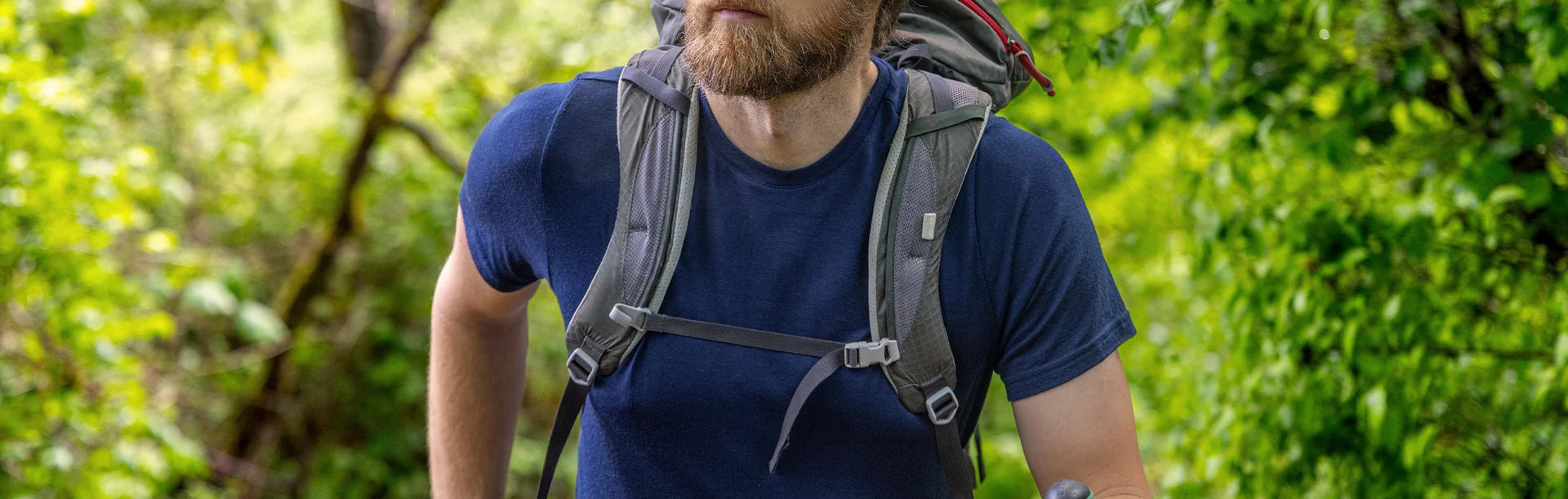
Three hours into a ridge hike, the morning sun disappears behind clouds and the temperature drops 10 degrees. You’ve been sweating on the ascent, and now that damp synthetic tee is turning cold against your skin. By the time you reach the summit, you’re layering up over a clammy base layer that’s already starting to smell.
This is the exact problem merino wool base layers solve. Merino handles the temperature swings, sustained moisture, and multi-day demands of hiking better than any synthetic or cotton alternative — and it does it without needing a wash for days.
Here’s why it works, how to set up your hiking kit by season, and what the real trade-offs are.
Five Reasons Hikers Are Switching to Merino
It Regulates Temperature as Conditions Change
Hiking rarely stays at one temperature. You start cold, warm up fast on the climb, cool down at exposed ridgelines, then heat up again on the descent. Your base layer needs to handle all of it.
Merino fibres create millions of tiny air pockets that trap warmth when it’s cold. When your core temperature rises, those same fibres release heat and wick moisture vapour away from your skin. At 18.5 microns, the fibres in Merino Protect base layers are fine enough to respond to temperature changes in real time — keeping you comfortable without constantly adding or removing layers.
This adaptability is why merino outperforms synthetics on varied terrain. For the full science behind it, see our deep dive into merino’s hiking and trekking benefits.
It Stays Warm When Wet
You will sweat on a hike. You might also get caught in rain, wade through a creek, or sit on damp ground for lunch. Every scenario soaks your base layer to some degree.
Merino absorbs up to 30% of its weight in moisture vapour without feeling wet. More importantly, it retains roughly 80% of its insulating value when damp — synthetics drop to around 60%, and cotton collapses almost entirely. If conditions turn and you can’t dry out, merino keeps working while other fabrics fail.
The moisture also triggers a heat-generating process called heat of sorption, meaning merino actually warms you slightly as it absorbs sweat. That’s not marketing language — it’s a measurable thermal reaction in the fibre’s keratin structure.
It Controls Odour for Days
On a multi-day hike, carrying fresh shirts for every day means wasted pack weight. Merino’s natural lanolin coating inhibits the bacteria responsible for body odour, letting you wear the same base layer for 3–5 days with just an overnight air-out.
Two merino tops in rotation can cover a full week on the trail. That’s real weight savings when you’re counting grams in your pack. See our guide to why merino resists odour for the science behind it.
It Prevents Chafing on Long Days
Chafing ends hikes. The combination of sweat, friction, and rough seams can turn a great day on the trail into agony by kilometre 15. Merino’s smooth 18.5-micron fibres sit gently against skin without the abrasion that synthetic fabrics cause when damp.
Pairing a merino base layer with merino underwear eliminates the two most common chafing zones — torso and inner thigh. For the complete prevention strategy, see our guide to preventing chafing while hiking.
It’s Lighter Than You’d Expect
A 170g merino tee weighs roughly the same as a synthetic equivalent but provides better temperature regulation and odour control. You’re not adding pack weight by choosing merino — you’re actually reducing it by carrying fewer layers and fewer backup shirts.
In an independent, unsponsored 30-day wear test comparing three premium merino tees, our 170g crew came out freshest on the odour test and held its shape best after 30 consecutive days of wear. Pilling was the trade-off — 100% merino pills more than nylon blends under pack straps. That’s the honest cost of choosing a pure natural fibre over a blend.
Follow Merino Protect for extra gifts:


Merino Wool vs Synthetic vs Cotton for Hiking
| Feature | Merino Wool | Polyester/Synthetic | Cotton |
|---|---|---|---|
| Thermoregulation | Active — adapts to body heat changes | Passive — no heat of sorption | None — traps moisture against skin |
| Moisture management | Absorbs 30% of weight, still feels dry | Wicks to surface, dries faster | Absorbs and stays wet |
| Warmth when wet | Retains ~80% insulation | Retains ~60% insulation | Loses nearly all insulation |
| Odour resistance | Natural — 3–5 days wear | Chemical treatment — fades with washes | Absorbs and holds odour |
| Chafing resistance | Smooth 18.5μ fibres — minimal friction | Can irritate when damp | Rough when wet |
| Pack weight efficiency | Fewer layers needed (odour control) | More layers needed for multi-day | Heaviest when wet |
| UV protection | Natural UPF 50+ | Varies by weave | UPF 5–10 |
| Sustainability | Biodegradable, renewable, RWS certified | Petroleum-based, sheds microplastics | Biodegradable but water-intensive |
| Dry time | Moderate | Fast | Very slow |
| Best for | All-day hikes, multi-day treks, variable weather | Short high-intensity hikes, hot climates | Never recommended for hiking |
The honest trade-off: Synthetics dry faster. If you’re doing a short, high-intensity trail run in consistent hot weather with access to washing, synthetic might edge merino on dry time. For day hikes with weather changes, multi-day treks, and anything where you need one layer to handle multiple conditions, merino wins.
How to Build Your Merino Hiking Kit by Season
The right GSM weight and layering setup depends on when and where you hike. For the complete guide to picking the perfect base layer, see how to choose a base layer.
Warm Weather Day Hikes (15°C+)
You need moisture management and UV protection more than insulation.
A 170g merino crew tee is your workhorse — lightweight enough to keep you cool on exposed trails, with natural UPF 50+ protection that synthetic tees don’t match. Add merino hiking socks to prevent blisters and keep feet dry. That’s it — no over-layering needed.
For the full summer hiking breakdown, see our guide to wearing merino in summer.
Three-Season Hiking (5°C to 15°C)
The sweet spot for most hikers. Mornings are cool, midday is warm, and ridgelines can be windy.
Start with a 200g merino long sleeve crew and merino thermal bottoms. The 200g weight handles the full temperature range without needing mid-day layer changes. Carry a wind shell in your pack for exposed sections.
Understanding the difference between base and mid layers helps you build a system that adapts to changing conditions without carrying unnecessary weight.
Cold Weather and Winter Hiking (Below 5°C)
Insulation matters, but so does moisture management — winter hiking still generates serious sweat on the climb.
Build your base with a 250g thermal set. Add a merino neck gaiter and beanie for exposed ridgelines. The 250g weight traps heat effectively during rest stops without overheating you on the approach.
For complete winter hiking kit advice, see what to wear hiking in winter and our winter layering system guide.
Multi-Day Backpacking
Every gram counts. Merino’s odour control means you carry fewer clothes.
Pack one 200g long sleeve, one 170g tee, one pair of thermal bottoms, and two pairs of merino socks. Rotate tops daily, swap socks at midday. This system covers 5–7 days on the trail at roughly half the clothing weight of an equivalent synthetic kit.
For packing strategies, see our one-bag merino packing guide.
Sizing note: Merino Protect base layers run slim for a close-to-skin fit that works well under a hiking pack. If you prefer a relaxed fit or plan to add a mid layer, size up.
FAQs About Merino Wool for Hiking
Is merino wool too warm for summer hiking?
No — lightweight 150–170 GSM merino actually keeps you cooler than many synthetics in heat. The fibres actively wick moisture and release heat as your body temperature rises, creating a cooling effect. Merino also provides natural UPF 50+ sun protection without chemical treatments. It’s one of the best choices for hot-weather hiking precisely because it breathes and manages moisture simultaneously.
How many days can you wear merino wool while hiking?
Merino’s lanolin-coated fibres resist odour-causing bacteria, making 3–5 days of continuous wear realistic with overnight air-outs. On multi-day treks, two merino tops in rotation can cover a full week. Synthetics typically need replacing or washing by day two.
Is 100% merino wool durable enough for rugged hiking?
Merino fibres bend over 20,000 times without breaking (cotton manages 3,200). It’s tougher than people expect. That said, merino works best as a base layer under a more abrasion-resistant outer shell — you wouldn’t bushwhack through thorns in just a merino tee. With proper care, a quality 100% merino base layer lasts 3–5 seasons of regular hiking. See our longevity guide for care tips.
What GSM weight is best for hiking base layers?
It depends on conditions: 150–170 GSM for warm weather and high-intensity hiking above 15°C, 200 GSM for three-season versatility across 5–15°C, and 250 GSM for winter hiking and cold exposures below 5°C. All Merino Protect base layers use 18.5-micron Australian merino wool, keeping them soft and itch-free at any weight.
How do you wash merino hiking clothes on the trail?
For multi-day hikes, you usually don’t need to — air it out overnight and wear it again. If you do need a wash, rinse in cold water with a drop of biodegradable soap and hang to dry on your pack. Back home, machine wash on warm with a gentle cycle. See our complete merino washing guide for detailed instructions.
Does Merino Protect offer a warranty?
Every Merino Protect garment comes with a 90-day warranty covering defects in materials and workmanship under normal use. Register your product for free to extend that to a full year — and get 15% off your next order. All base layers are certified by Woolmark, OEKO-TEX Standard 100 (Class I), and the Responsible Wool Standard (RWS), ensuring ethically sourced, quality-tested 18.5-micron Australian merino wool.
Start Your Next Hike in Merino
Merino wool earns its place in your pack by doing more with less — one fabric that manages temperature, moisture, odour, and comfort across every condition the trail throws at you. It’s not the cheapest base layer, but it’s the one that performs all day and across multiple days without asking for a wash.
Across more than 1,500 verified customer reviews, Merino Protect base layers hold a 4.8 out of 5 rating — and the most common feedback isn’t about warmth or odour. It’s about softness. Customers consistently describe them as “too comfortable to be wool,” which tends to catch first-time buyers off guard.
Browse the full men’s merino wool collection or women’s merino collection to find the right weight for your hiking style. For the most versatile starting point, grab a 200g thermal base layer set — it covers three-season hiking and doubles as your winter base layer under a mid layer.


Leave a comment